


What goes on a curry and bunny chow menu
- 1Bunnies by the loaf
- A bunny chow is curry in a hollowed loaf, sold by how much of the loaf you get: a quarter, a half or a full. Under All options, tick "Two prices on each line, like Small and Large" for the bunny section and name the two prices Quarter and Half. A full loaf, if you sell it, gets a line of its own.
- 2The filling names the dish
- List bunnies and curries by what is in them: beans, chicken, mutton, lamb, prawn. Go from the beans bunny up to mutton, so the prices climb down the list. Write "bunny" or "bunny chow", whichever is on your wall now.
- 3Curry with rice or roti
- A plate of curry needs its side said once. Name the section "Curry and rice", or "Curries, with rice or roti", and each line can then be just the curry. A section name is the place for anything true of every line under it.
- 4Breyani on its own
- Breyani, or biryani, is a dish of its own and gets its own short section. Spell it the way your customers do. If it is cooked on certain days only, say the days in the section name: "Breyani, Fri and Sat".
- 5Mild, medium or hot
- Heat is a choice the customer makes at the counter. The form has no heat tick, so say it once in the box for where you are and when you are open, as the example does, and not on every line.
- 6Rotis, naan, samoosas and sambals
- Breads and small things go last, one price each, with a count where it matters: "Samoosas (3)". Sambals or pickles that cost extra get a line; ones that come free need none.
- 7Cooking to order, and order-by times
- A home kitchen that cooks one curry on a Friday needs an order deadline. The form has no date or deadline box. Write it in words in the same box as your hours, "Order by Thurs 3pm", and check there is room in its two rows.
- 8Halaal, vegetarian and other claims
- The maker never adds a Halaal mark, a vegetarian sign or any other claim to your picture. If one is true of your kitchen, you can say so in your own words in the note at the foot. It is your statement, and it stays exactly as you type it.
- 9A photo of a bunny
- A bunny photographed from above is a brown square. Shoot it from the front at table height, with the curry running over the edge of the loaf, in daylight. The maker frames one photo under your name.
Curry and bunny chow menu design ideas
Six ways one curry menu can look, from a warm dark card to a red counter board. Tap a picture to start from it, then type your own dishes over the example.
- Curry house look, tall shape
- Curry house is warm and dark: maroon with a scalloped gold edge, section names on a red painted stroke and every price in gold. It is drawn from the curry and bunny chow posters of small restaurants here, which are dark with gold, cream and red.
- Kasi look in red, tall shape
- Kasi in red with white tabs is the counter board of a takeaway: loud, flat and quick to read from the door.
- Dark and serif look in wine, tall shape
- Dark wine with serif names is how a sit-down restaurant writes its curries. A thin line runs under each dish and nothing else is on the card.
- Curry house look in brown and saffron, A4 to print
- Brown with saffron orange, set for A4. Printed, it goes on the wall by the counter where the order is placed.
- Curry house look in green and gold, square
- Dark green with gold, on a square for a post. The four sections sit in two columns.
- Menu board in black and gold, A5 to print
- A black and gold board at A5, for the counter. Section names stand over a gold rule.
A curry menu, step by step
The example has four sections. "Bunny chow" has three bunnies, each with a Quarter and a Half price. "Curry and rice" has four curries with one price each, the side said once in the section name. Breyani has two lines. "Breads and sides" has a roti, a garlic naan, three samoosas and sambals. The foot gives the heat choices and the opening days.
Tips
- Name the two bunny sizes once, above the columns: Quarter and Half.
- Spell dishes as your own board does: breyani or biryani, roti or rotti.
- Put "with rice" in the section name and keep every curry line to the name of the curry.
- Count the samoosas in the name.
- If mutton is some days and lamb others, list the one you have today and remake the picture when it changes.
Sizes and printing
- Tall, for WhatsApp Status
- Tall like a phone screen. Best for WhatsApp Status and for Stories.
- Square, for a post
- Square. Best for a post on Facebook or Instagram.
- Printer page (A4)
- A4 is the size of a normal printer page. Print it at home or at a print shop. A home printer leaves a thin white edge.
- Half page (A5)
- A5 is half of a normal printer page. Good for a counter. A home printer leaves a thin white edge.
Questions
- Can I show quarter, half and full bunny prices on one line?
- No, a line holds two prices. Use Quarter and Half as the two columns and add the full loaf as its own line, with "full" in the name.
- Will the maker add a Halaal sign?
- No. It adds no mark or claim of any kind. You can state it in your own words in the note at the foot of the menu if it is true of your kitchen.
- Where do I say mild, medium or hot?
- In the box for where you are and when you are open, once. It is drawn at the foot of the menu.
- Can I take pre-orders for a Friday curry?
- You can say so in words, such as "Order by Thurs 3pm", in the note at the foot. The maker has no date or deadline box and takes no orders: it makes the picture only.
- What is the difference between a bunny chow and a kota?
- A bunny chow is a hollowed loaf filled with curry, and it began among Indian South Africans in Durban. A kota is a quarter loaf filled with slap chips and fillings such as polony, russian and cheese.
What you type is kept in this browser on this device until you clear your browser data, so you can come back, change a price and save a new picture. A photo and a logo are optional and are not kept for the next visit.
Closest to this one
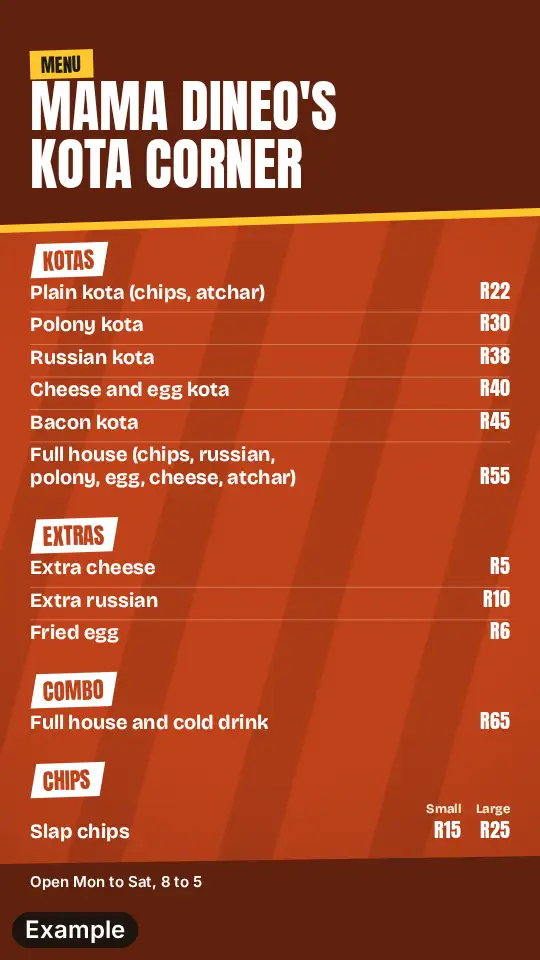 Kota menu
The kota is the other filled quarter loaf, with chips and polony where the bunny has curry.
 Gatsby menu
Masala steak in a long roll is a gatsby, sold by the half and the full.
 Chinese takeaway
Chow mein and fried rice from the same kitchen have a red and gold menu.
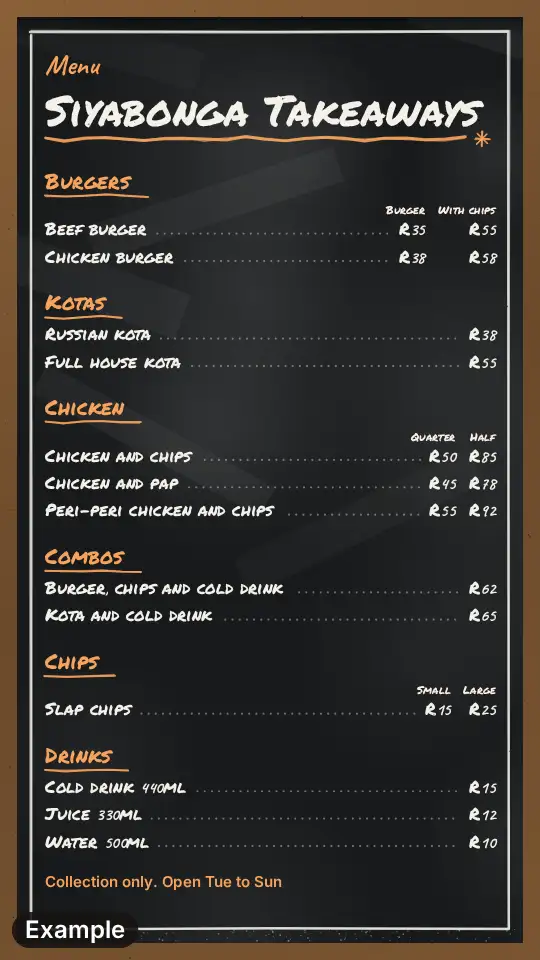 Takeaway menu
Toasted sandwiches, burgers and chips round the curries fit a takeaway menu in sections.