


What goes on a Chinese takeaway menu
- 1The order a Chinese menu runs in
- Soup first, then spring rolls and dumplings, then the main dishes, then rice and noodles, then anything sweet. Customers who know the food look for a dish in that order, so follow it even on a short menu.
- 2Pieces in brackets
- Starters are sold by the piece. Put the count in brackets after the name: "Spring rolls (2)", "Dumplings (5)", "Fried won ton (8)". If dumplings come steamed or fried at one price, say "steamed or fried" in the name.
- 3Veg, chicken, beef or prawn
- Many dishes are one dish with a choice of what goes in it. Where two choices cover it, go to All options, tick "Two prices on each line, like Small and Large" and name the two prices, say Veg and Chicken. With three or four choices, give each its own line.
- 4Dish names in plain words
- Write the names your customers order by: chow mein, chop suey, sweet and sour, fried rice. The picture shows exactly the letters you type, in the same plain capitals or lower case as everything else on it.
- 5The lunch deal
- A set price for two dishes at lunch is an offer several Chinese restaurants here post. Give it a section of its own with one line, "Any 2 mains with rice", and put the days and hours it runs in the box for where you are and when you are open.
- 6Sit down or take away
- If a price is for sitting down only, or take away costs more, say so in that same box in a few words. The form has one price for a line, or two with names: Sit down and Take away can be the two names for a section.
- 7A buffet price
- For a buffet, open All options and choose Specials at the top and type "Buffet, adult" and "Buffet, child under 10" as two specials, each with its price and "p.p." after the amount. House rules go in the note at the foot.
- 8One dish for the photo
- Stir-fried food shines under a flash. Take the photo in daylight, from above, of one dish in its bowl or tray on a plain table. The maker frames one photo; a grid of dishes is not something it draws.
Chinese takeaway menu design ideas
Six ways one Chinese takeaway menu can look. The first three are red or navy with plain capitals; none uses lanterns, dragons or brush lettering. Tap a picture to start from it.
- Red and gold look, tall shape
- Red and gold is a red ground, white capitals, one gold rule and a thin window lattice along the top and foot. That is all. It is drawn from what Chinese takeaways here print: red, white capitals and plain facts.
- Red and gold look in navy, A4 to print
- The same lattice and rule on navy with gold, set for an A4 print. It is the evening version, for a restaurant more than a takeaway window.
- Takeaway sign look in red and yellow, A4 to print
- Red with yellow is the home-made specials sheet taped to the counter, as loud as it gets. On A4 it is that sheet, tidied.
- Red and gold look in cream and red, square
- Cream paper with red lettering and a red lattice, on a square for a post. It prints with far less ink than the red ground.
- Cream card, the Sunday lunch look in red, tall shape
- A cream card with a red frame, serif names and thin lines: a quiet menu for a sit-down restaurant.
- Green chalkboard, A5 to print
- A green chalkboard at A5, for the counter. A board suits a kitchen whose specials change through the week.
A Chinese takeaway menu, step by step
The menu has four sections. "Soup and starters" has two soups, spring rolls and dumplings with their counts in brackets. Mains has four dishes with one price each. "Rice and noodles" has two lines with a Veg and a Chicken price. "Lunch deal" is one line. The foot says when the deal runs and that it is for sitting down or taking away.
Tips
- Count every starter: two rolls, five dumplings, eight won tons.
- Use one word for each kind of meat all the way down: chicken, beef, pork, prawn.
- If a dish is hot, put "hot" in its name; the maker draws no chilli signs.
- Keep the lunch deal to one line and one price.
- The cream and red colours use the least ink when you print.
Sizes and printing
- Tall, for WhatsApp Status
- Tall like a phone screen. Best for WhatsApp Status and for Stories.
- Square, for a post
- Square. Best for a post on Facebook or Instagram.
- Printer page (A4)
- A4 is the size of a normal printer page. Print it at home or at a print shop. A home printer leaves a thin white edge.
- Half page (A5)
- A5 is half of a normal printer page. Good for a counter. A home printer leaves a thin white edge.
Questions
- Can I number the dishes?
- Yes, by typing the number at the start of each name, such as "12 Sweet and sour chicken". The maker does not number lines for you.
- Can I show veg, chicken, beef and prawn prices in four columns?
- No, a line holds two prices. Use two named prices where two choices cover a dish, and separate lines for the rest.
- Can I add Chinese characters to the menu?
- The picture is drawn in the Latin letters of its own faces, so characters may not appear in the same lettering as the rest. Check the picture before you save it.
- Does the red look use lanterns or dragons?
- No. It has a red ground, white capitals, one gold rule and a thin lattice strip along the top and foot. Nothing else is drawn.
- Can I show an adult and a child price for a buffet?
- Yes. Make them two specials on a poster, each with its own price, or two named prices on one menu line.
What you type is kept in this browser on this device until you clear your browser data, so you can come back, change a price and save a new picture. A photo and a logo are optional and are not kept for the next visit.
Closest to this one
 Sushi menu
A sushi bar in the same restaurant sells by the platter and the piece count.
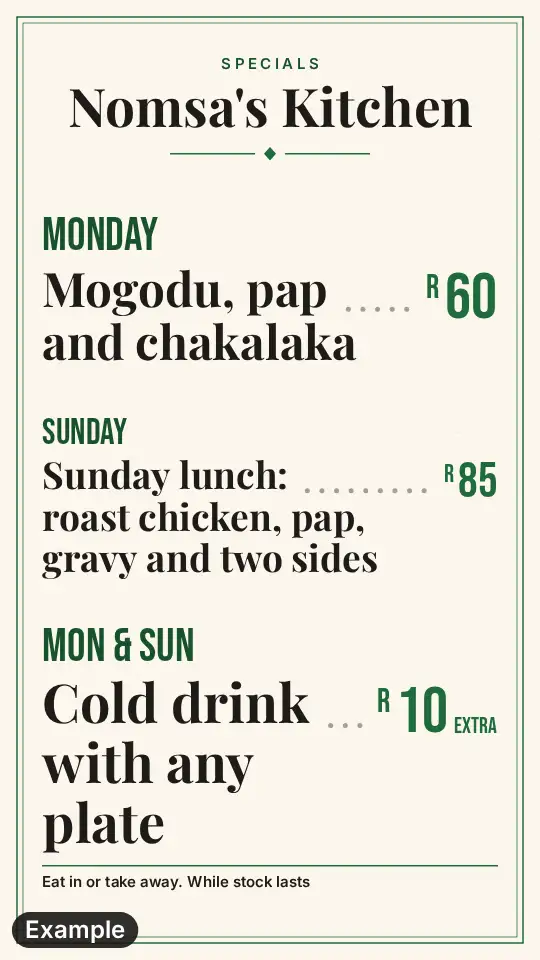 Lunch special poster
The lunch deal alone, with its days, can be a poster for the window.
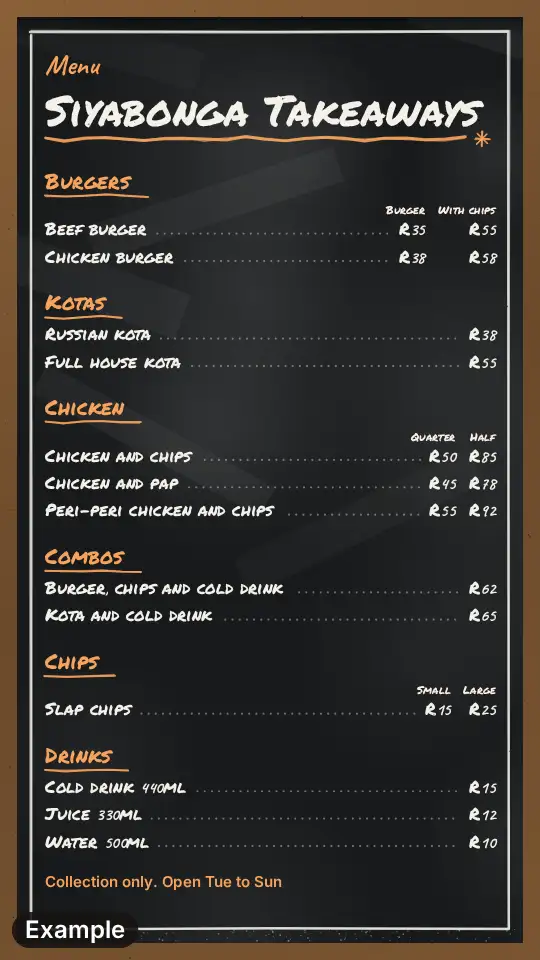 Takeaway menu
A takeaway that also fries chips and burgers can list everything on one board in sections.
 Curry house menu
Curry and rice by the plate, and bunnies by the quarter, have a menu of their own.