


What goes on a bakery menu
- 1Bread and rolls first
- A bakery menu runs from bread to treats: loaves, then rolls and other everyday items, then savoury pies, then sweet items and cakes. A customer coming for bread should see it first.
- 2What you make fresh each day
- Write the items you bake and sell today. Leave off the bread and pies you only bake on certain days. A short menu of fresh items reads better than a long one with gaps.
- 3The count in brackets
- Put the count in the name, like "Crusty rolls (6)", so the customer knows what they buy for the price.
- 4Savoury and sweet in sections
- Put bread and rolls in one section, savoury pies in another, sweet treats and cakes in more. Three to five sections are enough for a board.
- 5Cakes to order
- The menu can have one line for a birthday cake to order, with the price the bakery charges. Use the box for where you are and when you are open to say how to order.
- 6Allergens
- If allergens matter to your customers, keep a printed list by the counter.
- 7Changing the bake each day
- Keep the everyday bread on the board and change the sweet treats as they come out of the oven. When the bake changes, save a new picture, so the board matches what is in the case.
- 8Two sizes of cake on one line
- A cake can be sold by the slice and as a whole cake. Under All options, tick "Two prices on each line, like Small and Large" for the cakes section, then type Slice and Whole in the boxes "First price is" and "Second price is".
- 9An order is not a shelf item
- A tray of rolls for a meeting or a birthday cake is an order, not a shelf item. Say in the line at the foot how many days ahead to order, such as "Orders two days ahead". The picture does not take orders, so the customer phones or messages you.
- 10Where the menu goes
- Post the tall picture on WhatsApp Status when the bake changes. Print the printer page (A4) for the window and the half page (A5) for the counter.
Bakery menu design ideas
Six ways one bakery menu can look: a chalkboard in coloured chalk, a cream cafe card, a teal board with a yellow foot, a sage green card, a brick red board with a gingham border and a kraft paper card. Tap a picture to start from it.
- Chalkboard in coloured chalk, A4 to print
- Coloured chalk writes each item in a chalk of its own colour, the way a bakery board is lettered by hand. The prices stay white, so a colour never hides a number.
- Cafe card in milk and coffee, A4 to print
- Cafe card is the clean one: pale paper, a script name, thin rules and one coffee-dark ink. Nothing shouts, which suits a bakery counter.
- Teal painted boards, A5 to print
- Teal boards with a yellow band along the foot, a bright shop-front look. Printed at A5 it stands on the counter by the till.
- Sage green card, A5 to print
- Sage green with dark green ink. At A5 it fits a table holder or the counter.
- Brick red with a gingham border, A5 to print
- A gingham border on brick red, the look of a checked cloth on a bakery counter. A5 for a table or the counter.
- Kraft paper card, tall shape
- The same card on kraft paper brown, tall for WhatsApp Status.
A bakery menu, step by step
The menu has five sections: bread and rolls, savoury pies, sweet treats, cakes by the slice, and one line for a cake to order. Type each item with its price. The everyday bread comes first, so a regular finds it at once, and the cake to order sits last. The line at the foot says the bakery bakes fresh daily and takes orders for events.
Tips
- Keep the bread names short: white loaf, wholewheat loaf, not "our special artisan sourdough".
- Use the count in brackets: rolls (6), doughnuts (4), so the customer knows what they buy.
- List items you have today. When something sells out, make a new picture.
- A home kitchen menu can be shorter: bread, pies and a cake or two.
- Put the bread you sell most at the top of the board, where the eye lands first.
- Write whole or slice after a cake, so no one has to ask how much they get.
- Use the line at the foot for the day you bake, so the customer knows the board is current.
Sizes and printing
- Tall, for WhatsApp Status
- Tall like a phone screen. Best for WhatsApp Status and for Stories.
- Square, for a post
- Square. Best for a post on Facebook or Instagram.
- Printer page (A4)
- A4 is the size of a normal printer page. Print it at home or at a print shop. A home printer leaves a thin white edge.
- Half page (A5)
- A5 is half of a normal printer page. Good for a counter. A home printer leaves a thin white edge.
Questions
- Can I make a bakery board without paying?
- Yes. Making the bakery picture costs nothing, and the picture is yours to post or print.
- Is my bakery photo sent to you?
- No. Your photo and your logo are not sent to us, so add them again next time.
- Can I change the bread and cakes each week?
- Yes. Open the page, change the bread and the cakes, and save a new picture for the week.
- What size does a printed bakery board come out at?
- An A4 board is the size of a normal printer page, and an A5 board is half of that for the counter. The Print it button is in the Get your picture step, and you get a picture file.
- Can I add my logo or a photo of bread?
- Yes, both are optional, and each has its own box under All options. Neither is kept for the next visit, so add them again when you make a new board.
What you type is kept in this browser on this device until you clear your browser data, so you can come back, change a price and save a new picture. A photo and a logo are optional and are not kept for the next visit.
Closest to this one
 Coffee shop menu
A cafe that bakes its own bread and cakes can keep the drinks on one board and the bakes on another.
 Price list
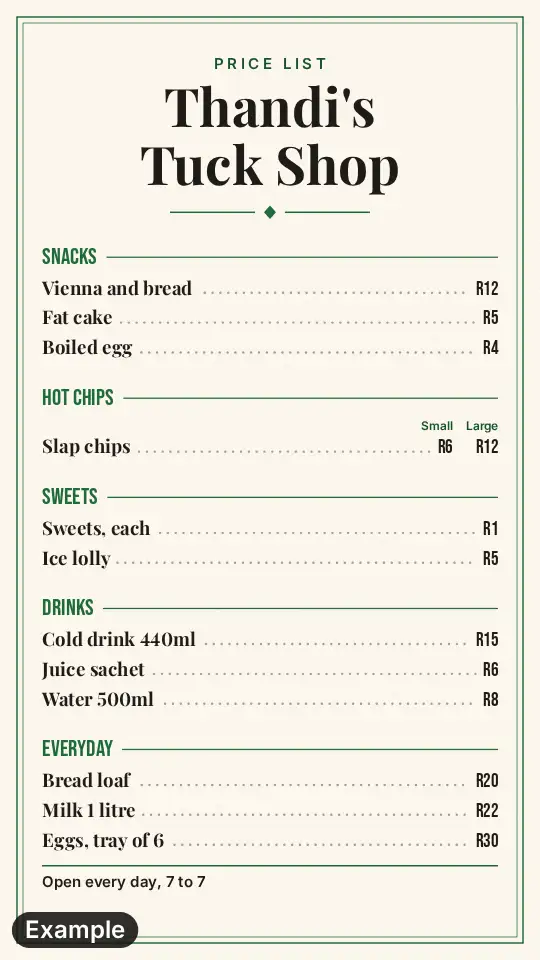
A home kitchen or a tuck shop that sells bread and pies lists them on a price list.
 Breakfast menu
A bakery that serves breakfast with fresh bread can have the breakfast on one board and the bakes on another.
 Lunch special poster
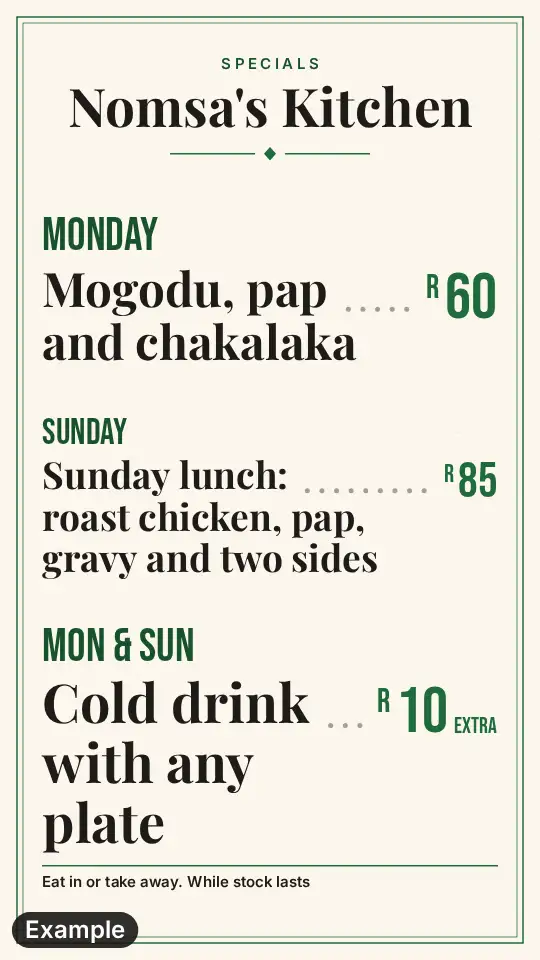
A special cake slice or pie of the day can have a poster of its own.